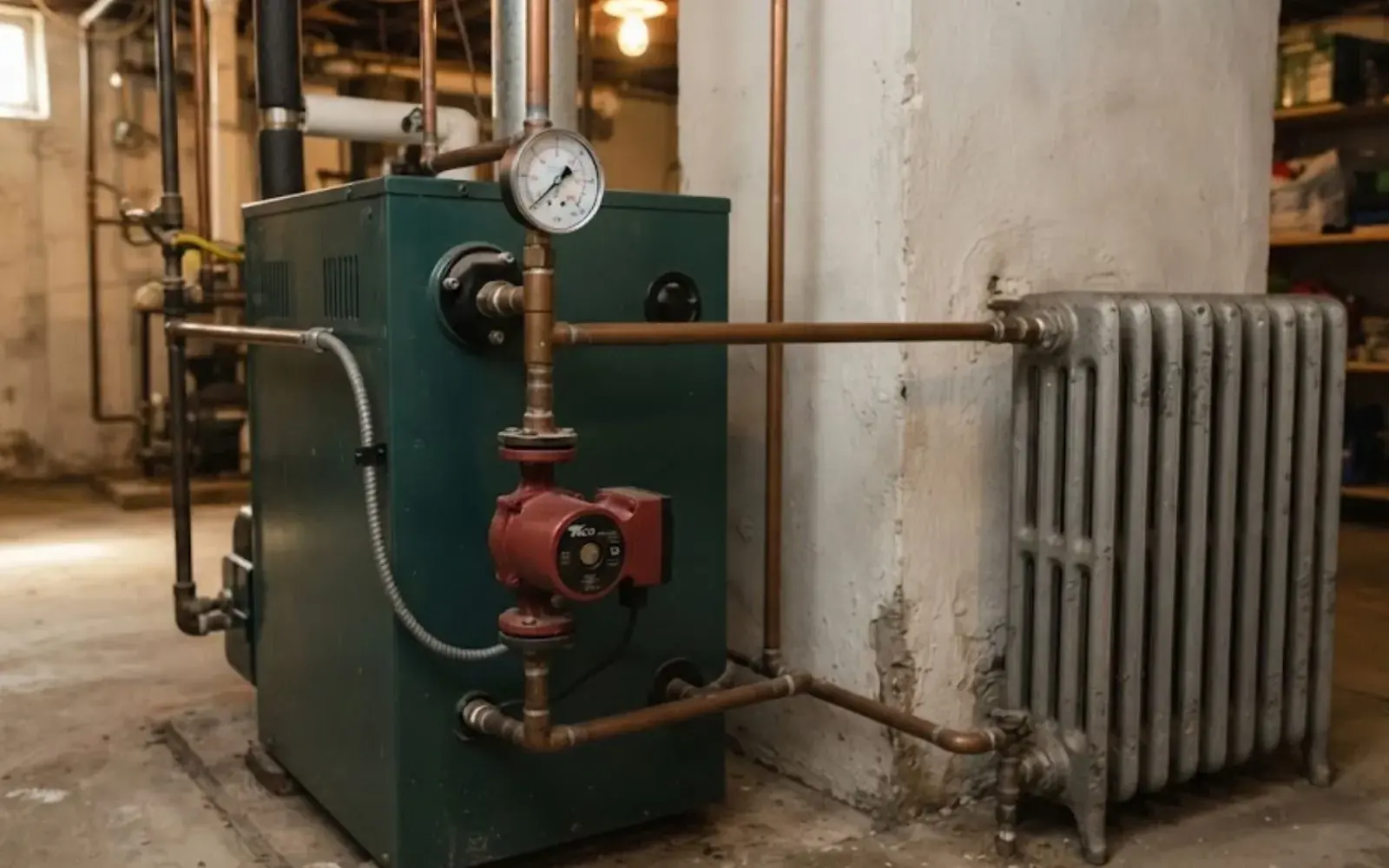
What boiler tubes do and how they fail
Inside a boiler, hot gases pass through or around tubes, coils or passages filled with water, and the water absorbs the heat. Over time scale, corrosion and thermal stress can crack or thin those passages. A small leak can wet the burner chamber, rust the controls and lose water pressure.
Whether a leaking tube can be repaired depends on the boiler type, its age and where the leak is. For a hands-on opinion, our emergency line is open 24/7, and our boiler repair page explains what we check.
| Boiler type | Where tubes or passages are | Typical repair outlook |
|---|---|---|
| Cast iron sectional | Cast sections, not tubes | Cracked sections are hard to repair, replacement is common |
| Fire-tube | Hot gases run inside tubes surrounded by water | Tubes can sometimes be replaced or plugged |
| Water-tube | Water runs inside tubes, gases outside | Tubes can be replaced, often in commercial units |
| Copper finned-tube | Water runs through finned copper in a compact boiler | Heat exchanger replacement or boiler replacement |
Signs of a failing tube or heat exchanger
Pressure that keeps dropping
The system needs frequent refilling with no visible leak outside the boiler.
Water at the base
Dampness or rust under the boiler can mean an internal leak.
Soot, odd smells or flame changes
A cracked heat exchanger can affect combustion. This is a safety issue.
Banging and kettling
Scale in tubes can cause noise and overheating.
Boiler leaking?
Call and a plumber will help you decide whether it is safe to run.
Safety first: when to shut it down
If you smell gas or see soot or scorch marks near the boiler, turn it off, leave and call the gas utility or 911 before you call a plumber. A cracked heat exchanger on a gas boiler can allow combustion gases into the living space, so carbon monoxide detectors should be working on every floor.
Repair or replace? A practical comparison
| Factor | Leans toward repair | Leans toward replacement |
|---|---|---|
| Age | Under about 15 years | Past 20 to 25 years |
| Leak location | A fitting, valve or accessible tube | Inside the heat exchanger or a cracked section |
| Repeat problems | First leak in years | Several repairs in a few seasons |
| Parts | Readily available | No longer made |
| Safety | No combustion concerns | Cracks or soot |
A new boiler can be more efficient, but a repair that restores a sound older boiler is often the better value for a short term. Our plumbers lay out both numbers. If hot water also comes from the boiler, see our water heater repair page for options.
Calumet City local note: older heating systems and winter
The 2025 water affordability plan for Lansing, published through the University of Illinois Chicago, reports that 39 percent of Lansing homes were built in 1959 or earlier. Homes from that era often had steam or hot water boilers with radiators, and some still do, but the plan does not say how many. If your house is from that group, ask what heating the original builder installed and how old your boiler is.
A boiler failure in winter can lead to frozen pipes, and the Calumet City Water Department's 2024 report says the city's water comes from Lake Michigan, which arrives cold. Keep your thermostat set well above freezing and know where your main water shutoff is. Our burst pipe repair page covers what to do if a pipe splits.
What affects the cost
Boiler type, access, parts availability, the extent of the damage and the hour of the call set the price. Replacing a heat exchanger can cost a large share of a new boiler, so we compare. A written quote lists the repair, the parts and the labor.
What a repair visit usually involves
A technician starts with a visual check, a pressure test and a look at the combustion side. The goal is to find out whether a tube or a joint is leaking and whether the heat exchanger is still sound. A small leak at a fitting is a repair. A cracked heat exchanger is a replacement.
Expect questions about the boiler's age, the heat type, any past leaks and recent water bills. Keep the manual and the last service record handy if you have them.
Carbon monoxide and boiler safety
A boiler that burns gas or oil can produce carbon monoxide if it is not burning cleanly. Keep working carbon monoxide detectors on every level. If an alarm sounds, leave the house and call 911 or the gas utility from outside. Do not try to repair a boiler that smells of gas or shows soot around the burner.
We service boilers in Calumet City and in Lansing, where older heating systems are common. Our service areas page lists the nearby towns we serve.
Boiler work follows the manufacturer's service instructions first, and any replaced piping or valves fall under the Illinois Plumbing Code. Ask whoever services your boiler what standard the repair meets and whether a permit applies in your village.
Questions about boiler repair in Calumet City
Usually not on a residential boiler. Replacement of the boiler is common because the exchanger is a core part. Commercial fire-tube and water-tube boilers may allow tube replacement.
Only briefly, and only if you can see no leak and smell no gas. Frequent refilling adds fresh water and speeds corrosion. Call a plumber.
A working detector on each level is a sensible safety measure for any home with fuel-burning equipment. Check local requirements with the city.
Annually is common. Follow the manufacturer's guidance.