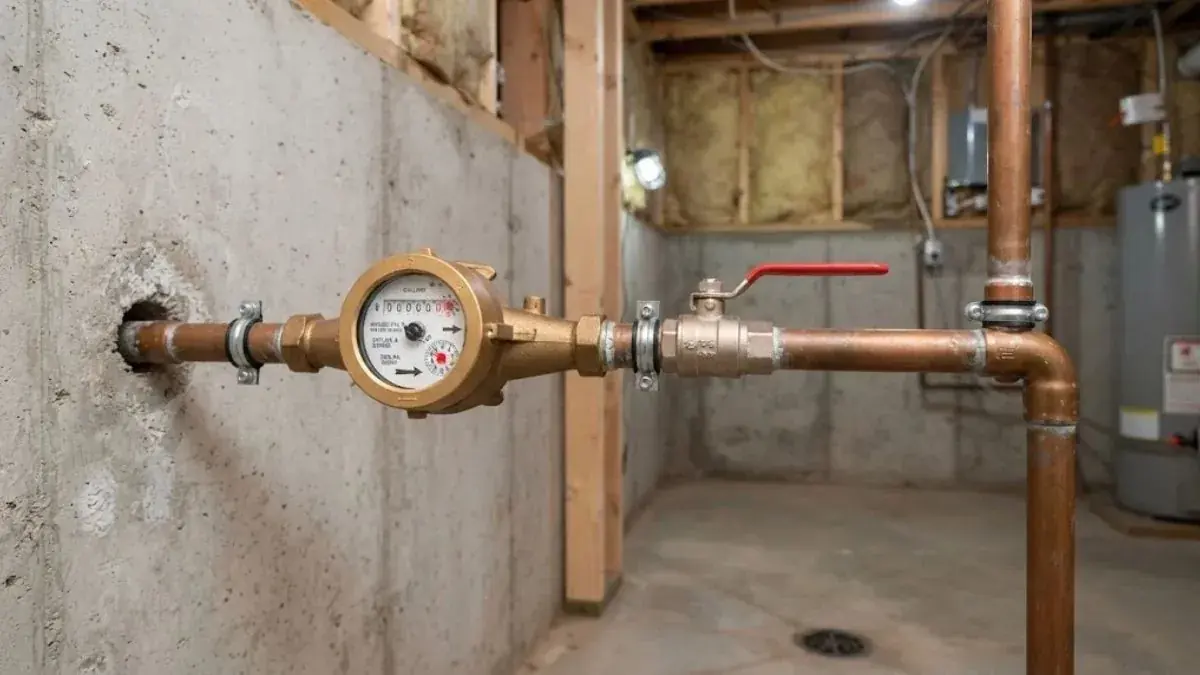
Start with a five-minute meter test
Turn off every faucet, the washer, the dishwasher and the ice maker. Find your water meter, usually in the basement near where the line enters, or in a pit outside. Look for a small triangle or gear on the dial that spins when water moves. If it keeps turning with everything off, water is leaving your system.
Write down the reading, wait 30 minutes without using water, and read it again. If the number has changed, you have a leak. If it has not, the extra usage may be something that happens only when a fixture runs, such as a toilet that sticks open.
Where high-bill leaks usually hide
| Source | How to check | Typical sign |
|---|---|---|
| Toilet flapper or fill valve | Add food coloring to the tank, wait 15 minutes | Color shows in the bowl without flushing |
| Dripping faucet or shower | Look and listen for drips after use | Drip that never stops |
| Water heater relief valve | Look for a drip from the discharge pipe | Wet floor near the heater |
| Irrigation system | Check zones and the backflow device | Wet lawn spots, hissing near valves |
| Buried service line | Meter spins with all fixtures off | Soft spot in the yard, low pressure |
Meter still spinning?
Call and a plumber will explain what the numbers mean.
A running toilet is the most common cause
A toilet with a worn flapper can waste hundreds of gallons a day without making much sound. It is often the cheapest fix. We replace the flapper and fill valve, and adjust the chain. If the toilet is old and has cracked porcelain or constant problems, our toilet repair and installation page explains when to replace.
When the meter says the leak is underground
If the meter moves with every fixture closed and your toilets pass the test, the leak is likely in the supply line. That could be a pipe under a slab, a line inside a wall or the service line between the meter and house. Our leak detection team uses sound sensors and pressure tests to pinpoint it. If it turns out to be the pipe from the street, see water service line repair.
Calumet City water bills and the meter
The city's water department reads and bills for water in Calumet City, and the 2024 water quality report lists the department as the contact for questions. If a bill is much higher than usual, call the department to ask when the meter was last read and whether the bill was estimated, and bring that information to us.
A leak that began after the last reading may only show in a later bill. If you can see a dial or a digital register, take a photo today, and again tomorrow. Two photos 24 hours apart document whether water is moving when no one is home.
What affects the cost of a meter and bill check
Cost factors
We quote a diagnostic visit up front. Repair costs depend on what we find.
Will the city adjust the bill?
Some utilities offer bill adjustments for repaired leaks. Policies vary, so ask the Calumet City water department. Keep your repair invoice and test results.
Want your real number? Call (773) 207-0518 and tell us what the meter shows.
The meter belongs to the water utility, so ask the Calumet City water department before you touch it. Plumbing on your side of the meter falls under the Illinois Plumbing Code.
High water bill questions
Yes. If water is running when no one is home, call our 24/7 line. If it is an active break, shut off the main valve first.
Hidden leaks in toilets, irrigation lines and buried pipes are common. The meter test and a toilet check find most of them.
A running toilet can waste a lot of water in a day, depending on the leak. A few drops of dye in the tank tells you.
No. The five-minute test is something you can do yourself. A plumber helps when the meter moves and you cannot find the cause.
Yes. We use sound sensors, pressure testing and tracers to pinpoint buried leaks.